|
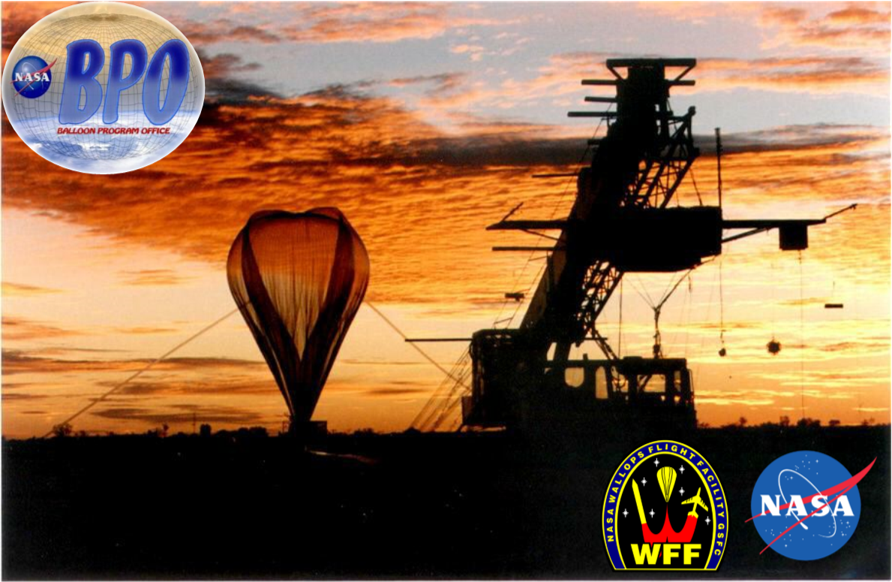
Super Pressure Balloon Launched January 9, 2011 The Super Pressure Balloon (SPB) launched January 9, 2011 at 2246Z.
Very smooth launch in excellent weather conditions. The balloon has reached float altitude, pressurized, and fully deployed. All camera and telemetry/command systems are performing nominally.
Follow along on the flight path with this link: www.csbf.nasa.gov/map/balloon0/balloon0.htm
|
|
BLAST Launched December 27, 2011 BLAST launched on December 27, 2011 at 04:06Z. As of January 2, BLAST was located at 81 deg. 50 min. South, 87 deg. 37 min. West on a heading of 289 deg. at 28 kts. The balloon altitude was 127.3 Kft.
The balloon flight carrying the CREAM VI payload was terminated earlier than planned after 5 days 16 hours. The balloon and payload landed on the opposite side of the Antarctic continent from McMurdo Station. Plans for recovery of the equipment are now underway and an investigation will determine the cause for earlier than planned termination of the flight. Science minimum duration requirements were achieved.
|
|
CREAM Launched December 21, 2010 CREAM launched from McMurdo Station on December 21, 2010 / 01:42 Z. This is the 6th flight of CREAM instrument.
CREAM PI Eun-Suk Seo wrote on the CREAM website: “What a beautiful launch! I would like to thank CSBF folks on the Ice for their tireless effort for this perfect launch after 3 attempts/cancellations in 3 days. Needless to say, this successful launch could not have been possible without support from NASA, CSBF, NSF/OPP and RPSC.
Thank you all for you strong support for CREAM!” www.csbf.nasa.gov/antarctica/ice1011.htm
|
|
Antarctica Campaign 1st Launch December 13, 2010
 BARREL launched December 13, 2010 at 21:44 Z.
The payload will measure bremsstrahlung X-rays produced by precipitating radiation belt electrons as well as variations in Earth's magnetic field. While the primary purpose of the mission is testing prototype hardware and launch procedures, the payload will study electron losses from the radiation belts in conjunction with the ongoing THEMIS satellite mission. Both practical NASA priorities (safety of astronauts and equipment in the radiation belts) and scientific ones (Space Sciences Steering Committee priorities in plasma physics and particle acceleration) will be addressed.
Congratulations Dr. Robyn Millan, Dartmouth College.
|
|